


mobile website optimisation: on a touchscreen, every pixel counts, every millisecond is felt and every hesitation on the part of the user is paid for in abandonment. AI now makes it possible to design, test and improve mobile interfaces faster and more reliably, by combining behavioural analysis, variant generation, audit automation and real-time personalisation. The challenge is not to look good on a smartphone, but to deliver a clear, light and conversion-oriented experience, even with an unstable network, only one hand available and limited attention span.
Accelerate mobile performance with data-driven decisions
On mobile, performance is a feature. AI helps to identify what really slows down a page (and what is insignificant), by cross-checking field data (RUM), loading traces and engagement signals. Rather than relying solely on a technical score, we can prioritise the optimisations that have the greatest impact on user perception: time to first useful rendering, visual stability, tap latency, speed of navigation between pages.
In a modern approach, AI can also recommend loading strategies adapted to the context: deferring non-critical components, proposing better-sized responsive images, compressing intelligently, or even preloading what the user is most likely to open afterwards. This logic is particularly effective when it is based on segments (new vs. repeat visitors, 4G vs. Wi-Fi, country/latency, low-end vs. high-end devices).

Build a robust mobile layout using assisted generation and validation
Mobile devices require stricter grids, more vertical blocks and clearer priorities. AI becomes useful when it doesn't draw randomly, but when it suggests tried and tested structures and checks their consistency: alignments, spacing, information density, legibility and tactile zones. A good practice is to generate several layout variants and then automatically filter them according to rules (accessibility, target size, line length, hierarchy consistency).
To solidify these choices, it is a good idea to anchor the design on grid principles: sections, columns, vertical rhythm and reusable components. A useful resource for framing these fundamentals is the basics of page layout using grids, sections and columns, which helps to make mobile pages more predictable and therefore easier to scan.
Automatic detection of mobile-first problems
AI can spot typical faults even before they go into production: buttons that are too close together (tap errors), text that overflows, insufficient contrast, carousels that are too heavy, intrusive pop-ups, or elements that cause page layout jumps. It can also simulate a variety of environments (small screens, zoom, larger system fonts, dark mode) and suggest prioritised fixes.
Visual hierarchy: making users decide at a glance
On a smartphone, visual hierarchy is not a plus: it's the prerequisite for users to understand what to do next. AI helps by assessing the salience of elements (titles, proofs, prices, CTAs), the clarity of paths and the consistency of information levels. It can generate hero section variants, reformulate micro-texts, or recommend content groupings to reduce the cognitive load.

Hotel Web Design is a Google partner with Google Hotels :
your availabilities and prices are continuously sent to Google, which displays free booking links to your booking page.
These links can represent around 10% to 15% additional commission-free bookings. Read the article on
Google's free booking links
.
To find out more about composition and prioritisation, you can use the following resources Mastering the art of visual hierarchy in design This complements the contribution of AI, which is most effective when it operates within a framework of explicit editorial and graphic rules.
Mobile typography: legibility, loading speed and brand consistency
Mobile typography must reconcile three often contradictory requirements: legibility (size, line spacing, line length), identity (font style), and performance (file weight, number of weights, rendering). AI can suggest pairs of fonts (headings/text), suggest appropriate sizes according to screen density, and pinpoint places where reading slows down (blocks that are too long, low contrast, lines that are too tight).
It also helps to rationalise: limiting unnecessary variants, choosing optimised formats, or favouring system fonts when speed is of the essence. If you're looking to strike a balance between aesthetics and technical constraints, this in-house resource is just the thing: the influence of AI on typography and fonts.
Images and media: AI to lighten without degrading
Media is often the first cause of slowness on mobile. AI makes it possible to automate time-consuming decisions: intelligent cropping to keep the subject on the small screen, generation of responsive versions, perceptual compression (reducing weight while minimising visual impact), and dynamic choice of format depending on the browser.
In an e-commerce or hospitality context, AI can also sort and classify visuals by conversion potential (clarity of the product, context, brightness), in order to highlight those that most quickly explain the offer. The expected result: less data transferred, a more stable interface, and content that remains convincing even on a 6-inch screen.
Mobile personalisation: adapting journeys without weighing down the interface
On mobile, personalisation is useful when it reduces friction, not when it adds screens. AI can help to provide more relevant navigation (shortcuts, highlighted content), adapt the order of sections according to likely intent, or modulate the level of detail according to behaviour (quick scan vs. close reading).
The point to remember: maintain editorial control and respect privacy. Wise personalisation on mobile focuses on non-sensitive signals (type of device, entry page, depth of visit, interactions), while maintaining brand consistency and predictable paths. The aim is not for each user to see a different site, but for the site to highlight, more quickly, what is most useful to them.
Automate A/B testing and design iteration on mobile phones
Testing on mobile is difficult: different screens, different behaviours, and the impact of performance on results. AI speeds up iteration by generating hypotheses (e.g. reducing a form, changing a product sheet structure, rewording a title), creating consistent variants, then analysing the results, taking into account biases (seasonality, acquisition channel, device segments).
Even more interestingly, some approaches go beyond classic A/B and come close to the multi-armed bandit: the AI progressively allocates more traffic to the winning variants, which limits the opportunity cost. On mobile, where a small improvement in clarity can produce a big gain, this continuous learning capability is particularly profitable.
Effects and animations: seducing without penalising the experience
Visual effects can improve comprehension (progression, tap feedback, transitions), but they quickly become counter-productive on smartphones if the page becomes heavy or if fluidity drops. AI helps to choose where an animation really adds value and where it should be removed. It can also recommend lighter alternatives (CSS rather than scripts, reducing layers, limiting simultaneous animations).
When it comes to scrolling effects, which are often appreciated but risky on mobile, it is useful to use best practice to avoid overload. See for example tips for creating parallax scrolling effects, Use sparingly and keep fluidity in mind.
Design systems and adaptive components: AI as co-pilot
A high-performance mobile site is generally based on a design system: standardised components, tokens (colours, spacing, typography) and assembly rules. AI can speed up documentation, check consistency (e.g. inconsistent margins between components), generate compatible variations (hover/active/focus states adapted to touch), and suggest missing components based on recurring needs.
It is also useful for offering adaptive components: the same module can change structure depending on the space available (list vs. cards, accordions vs. visible sections), without breaking the logic. On mobile devices, this adaptability needs to be kept simple: fewer options, greater clarity. AI is then used to maintain consistency despite the multiplication of cases.

Hotel Web Design is the 100% web agency dedicated to the hotel industry, supporting you in all aspects of digital communication: booking websites, natural search engine optimisation specialising in the hotel industry, Google Ads and Google Hotel Ads, social networking campaigns, graphic charters and logos.
Make an appointment today for free advice on optimal digital management.
Mobile accessibility: compliance and ease of use
Mobile accessibility is about more than compliance: it's also about the ability to use the site in real-life conditions (sunlight, fatigue, trembling, broken screen, screen reader). AI can detect insufficient contrast, ambiguous wording, inconsistent tab orders and tactile zones that are too small. It can also help simplify writing (shorter sentences, more explicit headings) and identify components that trap the user.
A good pragmatic indicator: if the AI points out an accessibility problem and the correction also improves general comprehension, you almost always have a direct conversion gain on mobile. Accessibility is therefore a lever for efficiency, not just a cost.
From prototype to online release: assisted generation and quality control
AI speeds up production by generating mock-ups, content and even code. But the value is most apparent when it is integrated into a control process: component review, reactivity checks (breakpoints), performance validation, and mobile checklist (thumb navigation, forms, keyboards, auto-completion, error messages).
To explore mobile site-oriented approaches more quickly, you can consult the external resource Creating a mobile-friendly site using AI, which illustrates how AI can support design without replacing quality requirements.
Understanding what's going on under the bonnet: models and deep learning
Without going into equations, it is useful to understand that most AI uses in design are based on models capable of learning patterns: associations between page structures and engagement, the relationship between information density and comprehension, or the correlation between latency and abandonment. This understanding helps to better frame the tool: AI suggests, you validate according to your business context.

To link these uses to more technical concepts, further reading is required. Neural networks and deep learning for AI in design.
Overview of tools: from generative web design to site generators
Depending on your maturity, you can use AI at several levels: inspiration (section variants), editorial assistance (headlines, micro-copy), production (images, icons), or generation of complete pages. The crucial point: keep your brief precise (targets, objectives, constraints), otherwise AI will optimise implicit criteria that don't match your mobile priorities.
This external resource can be used as a basis for an overview of uses on the design side: the possibilities of web design using AI. And if you're looking for a fast-paced approach, you can also look at a free IA website generator, The result must be adjusted for performance and mobile ergonomics.
Web and mobile applications: convergence of best practices
The boundaries between websites, web apps and mobile apps are becoming blurred. Component, state, cache and navigation logic are coming together, and AI is being used on both sides: UI improvement, recommendations, test automation, log analysis. For a broader perspective on this transformation, you can read how artificial intelligence is revolutionising web and mobile applications.
Pragmatic roadmap: how to deploy AI without complicating matters
To achieve concrete results, a simple approach is to move forward in stages:
1) Define mobile objectives: main action, key pages, device segments, performance budgets (weight, time, stability).
2) Instrumenting: key events, funnels, field performance data, while remaining minimalist.
3) Use AI to detect and prioritise: UX frictions, real slowness, accessibility faults, UI inconsistencies.
4) Generate 2 to 5 targeted variants (not 50): one hypothesis = one main modification.
5) Test, learn, standardise: integrate the winners into the design system and document the rules.
This method avoids the common pitfall of introducing AI everywhere without any measurable benefit. On mobile, gains often come from small, repeated improvements: more explicit wording, shorter form, better reframed visual, section moved higher, lighter media.
Conclusion: AI as an accelerator for mobile requirements
AI does not replace strategy, user understanding or rigorous design. On the contrary, it speeds up what takes the longest: diagnosing, proposing, verifying, testing and iterating. Used correctly, it helps deliver mobile interfaces that are faster, easier to read, more accessible and more effective - without sacrificing brand consistency.
Your quote in 5 minutes
If you want to quickly assess the priority optimisations for your mobile pages and define a concrete action plan, you can request a quote in 5 minutes.






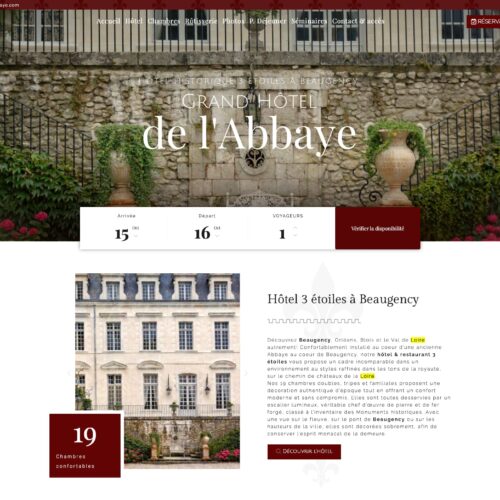












Hotel Web Design is a Google partner with the Google Hotelsincluding our customers benefit on a daily basisGoogle search: information about your accommodation, availability and prices is sent continuously to the search engine, which displays free booking links from the Google search directly to your booking page. These free links represent around 15% of additional commission-free bookings for our customers in 2022! Read our article on free booking links from Google
Booking / reservation website
-
Booking services for hotels and holiday rentals
- Turnkey site with administration interface training on delivery
- Adapted logo and graphic charter. Possibility of using your existing elements
- Hospitality SEO
- Integration of reservations module
- or integration of an external booking engine (Reservit, Availpro, Mister booking, Roomcloud, etc)
- Integration of specific HTML elements (review portals, customer reviews, weather, press, pop-ups, direct chat, etc.)
- Secure SSL / HTTPS
- Multilingual
- Website user interface
- Hosting and domain name
- Fast delivery

Hotel Web Design is the web agency 100% dedicated to the hotel industryWe can help you with all aspects of digital communication for your accommodation: booking websites, natural referencing specialising in the hotel industry, Google Ads referencing and Google Hotel Ads, social networking campaigns, graphic charters and logos for hotels.
Make an appointment today for free advice on how to optimise the digital management of your accommodation.